by Audrey Fishwick
Browfoot Farm lies under the slope of Cringlebarrow wood, to the south of the Silverdale Road where it turns the corner into Yealand Storrs. It is one of the oldest buildings in thearea and bears a date stone which reads W/IM 1627. I hope to research further into its earlier history, but I have already started to make records of its twentieth century history. As you will see in these extracts the records refer to a way of life that is already gone.
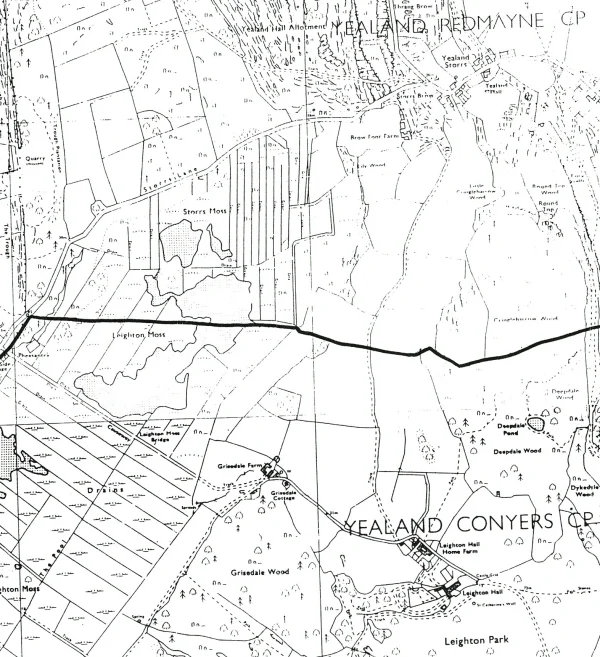
Browfoot is a tenant farm, the property of the Reynolds’ family of Leighton Hall. From the early 1900’s the farm was occupied by the Seed family. George, the father, Lizzie his wife, the daughter of near neighbours, Mr and Mrs Shaw who lived at Storrs Cottage. There were five children: – Polly, Agnes, Tibby, Jack and Alice.
Browfoot in World War II
The only illumination was by oil lamp and candlelight, and all the cooking was done on the open fire (though there was a fire-side oven for baking). There was one cold tap in the
kitchen and hot water had to be obtained by heating on the fire. Sanitation was primitive. At the back of the house (round the side and through the field) was an earth closet. It was not till the present tenants took over in 1960 that a water closet and bathroom were installed.
The family rose at six o’clock. The cows were usually waiting in the pasture and as soon as the yard gates were opened they would loiter into the milking shippon. In winter it would have to be lighted with oil storm-lanterns which were hung on the beams. Hay was thrown down from the barn overhead through pop-holes and landed in the gangway (called the fodder gang) in front of the cows. Milking was done by hand with milkers precariously perched on three-legged stools, leaning with heads and shoulders against the cows’ warm bodies, while the milk flowed in a tuneful rhythm into the buckets.
As each bucket was filled it would be taken across to the dairy where it was poured into the cooler. From there it ran into the waiting milk kit (or churn). Three of these were usually filled, then taken on a flat bogie and put on to the stand to wait for the milk lorry to pick them up. The women then washed the dairy (though not till after breakfast – porridge, home- produced bacon that had been kept hanging from hooks in the ceiling, and sweet tea. )
Sheep were kept at Browfoot, about 170 of them. They were no real bother except at lambing time, clipping time and dipping time. Usually men from farms round about came to
help with the clipping. They had with each other to see to be fed. Farms used to vie with each other to see who could put on the best meal and Browfoot always had a reputation of being one of the best. Huge dishes of hotpot were made, along with large enamel bowls of creamy rice pudding (baked long and slowly in the oven) and plates of apple pudding. Down the centre of the large living room was a very long table round which sometimes 18 people sat. The meal would be quickly devoured and then back to the clipping again.
At dipping time it was the same procedure. Men from other farms helped out – each farm had their own time for these jobs and the other farms fitted in.
Haytime and harvest work was all done with horses; cutting, scaling1, rowing-up and carting. Browfoot had three horses; Blossom, Jewel and Flower. They moved at an ambling pace and nothing and nobody could get them to go any faster; but they could keep going all day long and most of the night as well if it was necessary to get the hay in. It usually took two weeks of workable weather i. e. warm and dry to make the hay.
Winter threshing was undertaken by the local contractor, Jack Graves from Silverdale, who arrived with his noisy, smelly monster. Once set in motion it was a horror to go near, with its mass of turning, flaying belts which worked the various parts. It swallowed the corn at one end and coughed out bags of oats and tufts of loose straw at the other. A team of about eight to ten men were needed to keep the work flowing, two or three bringing the sheaves, two on top of the machine feeding it and three or so carrying the bags of oats to the granary, while the remaining men stacked the straw in the barn for winter bedding.
After work was done for the day each man would enter the back kitchen and have a strip-off wash in the large, shallow stone sink. After much scrubbing with carbolic soap they would emerge all red and shining. with their hair wet and plastered to their heads. Then to sit down at the large table and eat enormous meals. After supper games of cards or dominoes would take place. A large bag of white conical shells would be produced, and each player would be allocated twenty each, and I guarantee noone at Monte Carlo could be more seriously or dedicatedly determined than these folk to win their neighbour’s shells.
In the 1950’s modernisation stepped in, in the form of electricity. Tractors became the thing and suddenly life was not quite the same. I particularly missed the horses. Talking to a
tractor as you go about the work is not quite the same thing!
In 1959, after Mr Seed’s death, the farm was sold up. The sale was on a grey November day. Item after item was sold. Some, like the lovely old brass oil lamps, stood forlornly about the dustbins waiting for the rubbish men to take them away. All the furniture was sold and the animals left one by one. A great heaviness of heart crept over me and I knew life would never be quite the same again.
Note:
The author is the daughter of a cousin of Lizzie’s. She was a frequent visitor to the farm and spent most of the war years there
- Scaling (or skailing) Turning the hay. The horse drawn machine had a row of wheels with long tines to pick up the hay and toss it in the air to dry. ↩︎
Published in Mourholme Magazines Issue 18 1992