by Winifred Briggs
Robert Withers of Kellet, who died in the 1680’s, left £6 a year for the teaching of Quaker children at Yealand, and from 1705 a schoolmaster was appointed for this purpose, the school being held at the Backhouse farm, at Hilderstone, Yealand Redmayne. In 1764 the old cottage next to the Conyers meeting house was bought for £40 and altered for a school at a cost of £20. It was enlarged considerably in 1851 and again in 1880, with stables underneath to hold the horses and gigs of Friends coming to meeting. Among the meeting house records shown to the Mourholme Society last summer are a school Admissions Register beginning in 1866, and a log book. Yealand Friends’ School belonged at that time to the British and Foreign School Society, which required its members to keep a daily log, so that we have an illuminating picture of the school’s life from July 1866 to June 1895. There was not always anything special to report; ‘Ordinary progress’ is a fairly frequent entry, however, that progress was usually commended by the regular inspection reports included in the log, and discipline and order were often ’very good’.
At that time the school was not for Friends’ children only. The log records time off allowed for Catholic feast days and for the church Sunday school treat.
Holidays
Holidays seem to have been at the discretion of the master and were given on vastly differing occasions. The wedding day of Miss Bolden of Warton, many funerals, ‘a wild beast show’ at Burton, the holding of a Friends’ monthly meeting (which would need the premises) were some of these. However, there were no long holidays at Christmas or Easter or Whitsun (only for a local ‘Club Walk’); there was a-four-week break at Midsummer and they were back at school in August. One entry records children’s listlessness in the heat.
Attendance
Attendance was 30-65 on average in the early years of this log, increasing in the 1880’s to 120 at times. Numbers were much affected by weather and the call of field, work or an attraction like Lancaster Cheese Fair; an entry for April 1867 reads ‘Some of the children away collecting pace-eggs’ (Easter eggs). As Orlando Pearce, the master, observed cynically in April, 1869, there was ‘a good deal of outdoor occupation for the big boys, such as potato planting, peeling bark, picking stone and weed…’.
Staff
Staff consisted, from 1866 to June 1871, of the master and the sewing -mistress. That year saw the addition of the first pupil teacher, who occasionally found himself in sole charge. In 1879, when George French was already headmaster, a post he held for 18 years, an assistant, George English, was appointed. He stayed only ten months but was replaced. There were always pupil-teachers, one if not two, on the staff.
Curriculum
The Three R’s were relentlessly demanded by the continual examinations and had to have pride of place, but Yealand children also learnt Scripture, Geography, and a little History. What the boys did while the girls sewed is not recorded. In March 1875 the master records that their reading practice was from the Lancaster Guardian. Earlier, in March 1867, he had noted, ‘Gave the children an opportunity of witnessing the eclipse of the sun today, and explained to them how it was brought about’. Homework was set.
Treats
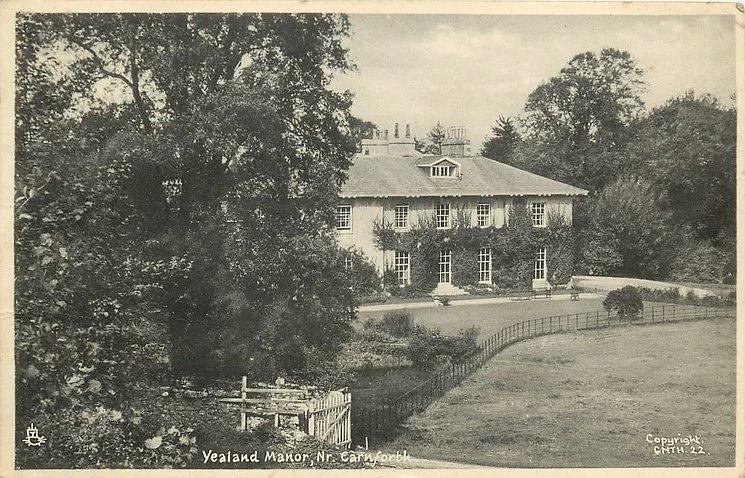
At first there were oranges and nuts at Christmas, and coffee and cake before the Midsummer break, but January 1869 was special: ‘in the afternoon took the children on the Summer-house Hill for a scramble after sweets and gingerbread, given by Mrs Ford’. Mrs Ford lived at what is now Yealand Manor and took a considerable interest in the school. Towards the end of the century a Christmas tea-party became usual.
Discipline
In September 1868 the master records that he ’Cautioned the boys about using gunpowder during playtime’; in March 1879, ‘having discovered most of the upper boys smoke cautioned the whole school on the habit and communicated with the smokers’ parents’. On one occasion boys had to be reprimanded for ill-treating a ram on Summer-house Hill, and also for bird-nesting. Mrs Ford’s essay prize on ‘Why we should be kind to animals’ (December 1860) seemed a necessary corrective.
Parents’ Occupation
The Record of Admissions of 1866 shows ‘Parental Occupation’ to be varied: veterinary surgeon, farmer, auctioneer, labourer, butler, manservant, groom, coachman, gardener, gamekeeper, agent, grocer, innkeeper, blacksmith, mason, joiner, wagon mender, timber dealer, manure agent, maltster, washerwoman, navvy, dressmaker, engine-driver, plate-layer.
Residence
The Record of Admissions also shows that pupils came not only from the Yealands, but from Warton, Borwick, Priest Hutton, Crag Foot, Tewitfield, Gunnerthwaite, Carnforth and Silverdale. As late as the first two decades of this century, after which the school closed, pupils continued to come from far afield. Miss Gathercole of Yealand Conyers, who left in 1917, recalls a family coming from Arnside, taking a train to Silverdale and walking from there. This distance in bad weather was the main attendance problem. Sometimes they struggled in, as in the log book of March 1892: ’children sent home on Thursday morning as most of those who came were wet through’. Bad behaviour on these long walks is recorded: in March 1867 the Silverdale boys were threatened with expulsion for this. There was one tragedy: in May 1875 Mary West from Borwick was knocked down on the level crossing by a northbound train on her way to school, and died in Lancaster Infirmary.
Yealand Old School (after a woodcut in Elizabeth Brockbank’s Richard Hubberthorne (1929))
Published in Mourholme Magazine Issue 3 Spring 1983