By Nancy Thomas
In his talk to the Mourholme Local History Society on 2 Dec 1982, Dr J. D. Marshall pointed out that literacy in the northwest was consistently high from at least the 17th century, dipping only in urban areas under the pressures of 19th century industrialization. High standards of literacy, he argued, were a reflection of the high value placed on education by society in the northern counties and were very often reflected by the high achievement of northern sons (and daughters, one ‘ hopes) who went to seek their fortunes in the south.
It seemed an interesting project to try to discover if Warton parish fit the pattern described by Dr. Marshall.
One measure of literacy is whether a person writes his name or makes his mark. It is an imperfect measure, of course, for although it is probably safe to say that a person who uses a mark is illiterate, it does not necessarily follow that a signature is a sign of reading ability. Nevertheless, it is an easy measure to use and probably does indicate at the very least a positive movement toward full literacy.
From 1754 onward the published registers for Warton parish indicate whether the men and women married in the church signed the register with a mark or a name. Between 1754 and 1800 inclusive, 442 marriages are recorded. Of the 442 men, 342 or 77.4% wrote their names. Of the 442 women, 243 or 55% wrote their names. Dr. Marshall noted that between 1660 and 1764 in Hawkshead parish 63% of the men could sign their names, and in sample parishes in North Lancashire between 1750 and 1760 80% of the men and 30% of the women could sign. The men of Warton, therefore, seem to fit the average, and the women to be considerably above the average.
Unfortunately, when the printed marriage registers begin to record marks and signatures, they stop recording residence by township. By using other records, however, especially baptism and burial records, it is possible to ‘locate’ couples. For the same years, 1754 through 1800, 43 couples are identifiable as Silverdale residents. Of the men, 42 or 97.6% and of the women, 28 or 65% wrote their names. Possibly these surprising figures point more to errors in the researcher’s methodology or the perverse nature of chance than to the excellence of the educational opportunities in Silverdale in the last half of the 18th century. And if so, the error is compounded by the fact that the one bridegroom who could not write his name was not a Silverdale native, but an out-of parish lad marrying a Silverdale girl, making 100% a truer literacy rate for Silverdale men.
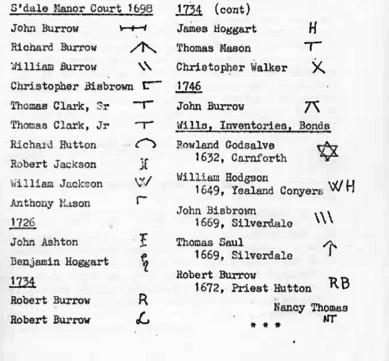
There is other evidence for Silverdale. The Silverdale Manor Court Books have been preserved and date from 1671 to well into the present century. The written records of the Court proceedings are occasionally signed by the men who made up the Jury. At the Court held on 18 May 1698, a fine list of 13 names appears with carefully drawn marks beside 10 of them. Only 3 men wrote their names. The Court held on 10 June 1734 was a special occasion. By the General Consent of the inhabitants within the Township of Silverdale, Haweswater Moss was to be divided and equal shares were to be allotted to each tenant. Nineteen inhabitants were present, probably very nearly all the customary tenants of the Manor. Of these 19, only 7 made their marks whereas 12 wrote their names. In other words, in 1698 23% of the Jury could sign while in 1734 the figure was 63%. Another freak result? Or had something happened between 1698 and 1734 to account for this rise in literacy?
If a society values education, it supports schools and schoolteachers. From before 1600 Warton parish was provided with at least one formal school. In 1595 the Free Grammar School at Warton was founded and endowed by Matthew Hutton, then Archbishop of York. As is pointed out in another article in this magazine, the Quakers ran a school in Yealand throughout the 18th and 19th centuries. Both these schools were supported by gifts from 18th century benefactors. But it is doubtful if either school could have made a very dramatic impact on the ability of Silverdale children to write, given the geography of the parish. Silverdale may, in fact, offer a special illustration of a community’s attitude toward education – and the arrangements made to obtain it.
A few words of historical background are necessary. From ancient times Silverdale had had a chapel. Its function as a Chapel of Ease from medieval times was to provide the community a more convenient place for certain religious observances than the Mother Church at Warton, so many difficult miles away. From Lucas’s History of Warton we learn that it had suffered a long period of neglect and deterioration during the 17th century. ’Ancient inhabitants’ alive at the end of the century could remember a time when the Chapel had had £40 a year belonging to it which had been lost through ’iniquity and different Turns of the Times, and for want of looking after’. Both the pastoral care of the inhabitants and the physical care of the chapel fabric had eroded, so that by the end of the 1670’s dissention was rife within the flock and decay had ruined the building.
But at the end of the 1670’s a change occurred. The chapel was rebuilt in 1679, presumably by and at the expense of the inhabitants, a new young curate appeared on the scene in about 1682, and by 1687 the inhabitants of Silverdale and their curate, Mr James Atkinson, were resolutely engaged in a struggle with Mr Thomas Lawson, the Vicar of Warton. The Vicar was not pleased ty the developments in Silverdale. Not only did a well-supported Chapel of Ease threaten to divide his flock, he thought, it also threatened to diminish his income, by fees lost and by the amount of the £5 stipend he was being called upon to find for the Silverdale curate from his own pocket. The details of that struggle, interesting though they are, are not our subject here.
What is important is the person of Mr James Atkinson and the fact that he is referred to throughout the papers dealing with the dispute as ‘the Schoolmaster’ quite as often as he is called the Curate. It is probable that James Atkinson was a member of an ancient and important Silverdale family closely associated with Challan Hall and Waterslack, with connections in Beetham. It is certain that he was educated, possibly at Beetham School, that he was a qualified schoolmaster, and that he served the community in that capacity.
In 1722 in answer to a Diocesan questionnaire the Vicar of Warton stated that ’In Silverdale the Curate teaches in his own House English and Latin’. He died in 1727 after more than 40 years as curate and schoolmaster. To what degree he and his family were the driving force behind the resurgence of community spirit and determination in 1679 can only be guessed, but his presence in the community during those 40 or more years must have had a significant impact which the Manor Court literacy figures may in part reflect.
In 1728, one year after the death of the ‘Schoolmaster’, Joseph Burrow of Waterslack died. He founded in his will what the 19th century Charity Commissioners called the ‘Burrow’s Charity’. Their Reports describe it as a rent-charge of £3 on certain pieces of land to be disbursed annually, £1 to the poor of Silverdale and £2 to the Reader of Silverdale Chapel. It seems a routine enough endowment for the period. But when one examines the will itself and reads it in the context of events, it takes on a critical new significance. He provides:
‘a payment of £2 yearly to the reader of Silverdale Chapel provided said reader do live at Silverdale frequently and do qualify himself to execute the office of schoolmaster and teach boys and girls to read and write, and also grammar and other useful Books; and I order constitute and appoint (if the Reader for the time beeing doe conform to the rules sett down) that the Churchwarden for the time being there being and his successors forever do take care for the raising yearly of the said summe of two pounds and paying the same to such a reader and schoolmaster and not otherwise.’
This attempt to insure the continuation of a Schoolmaster/Curate is a clear indication of the value one member of the community at least placed on education. It should probably also be read as an acknowledgement of James Atkinson’s importance to the community. Whether Joseph Burrow’s hopes were realized or not can be discovered by a look at the credentials of the curates appointed to Silverdale Chapel during the rest of the 16th century.
In 1756 Mr Francis Haygarth, Schoolmaster of the Free Grammar School at Over Kellet, was appointed. He was succeeded in 1759 by Mr Thomas Turner. A letter survives from Mr Turner to the Bishop of Chester, a sort of 18th century C.V. It is dated March 17, 1759, from Silverdale and reads in part as follows: ‘I was born at Slyne in the parish of Bolton- Educated at the free Grammar School in Lancaster under the Care of the Rev’d William Johnson with whom I continued ’till I was elected Master of a Grammar School at upper Kellet from whence in November Last, (the time Mr. Haygarth was removed by your Lordship to Mobberley) I came hither; where I officiate as Lecturer, and employ myself in Teaching.’
In 1765 Richard Bailey, Schoolmaster at Beetham, succeeded Thomas Turner. Thomas Hest, Schoolmaster at the Free Grammar School at Warton, seems to have served at Silverdale at two different periods. Even into the 19th century Schoolmasters were serving as curates at Silverdale. Richard Knagg, Master of the Warton Free Grammar School, was appointed Curate in 1807 and served until 1820.’ However important James Atkinson and Joseph Burrow were in establishing the precedent, it is quite clear that throughout the 18th century Silverdale residents were served through their Chapel of Ease by an educated and fully qualified schoolmaster, and whatever measurements are used and however results may vary, the conditions did exist in Silverdale which could have produced high levels of basic literacy.
The marks used in earlier centuries are generally much more interesting than the simple crosses one might expect. Following are some of the ones used by local inhabitants.
Literacy In 19th Century Warton
By Jean Chatterley (Thanks are due to Rev. Oddy who allowed access to the registers.)
Following the article above on literacy in Silverdale in the 18th century, I thought readers might be interested in some research done on the Warton marriage registers for part of the 19th century. Between August 1837 and December 1875, 500 weddings were registered at Warton Parish Church. Of the 1000 brides and grooms, 225 made their mark, usually a simple cross, instead of signing their names. This would indicate a literacy rate of 78%. In more detail:
Date
- 1840-1849
- 1850-1859
- 1860-1869
- 1867-1876
Number Married
- 248
- 254
- 250
- 288
Numbers Marks and Approx Literacy
- 75 70%
- 49 81%
- 54 78%
- 50 83%
These figures show a steady improvement towards the second half of the century. Of the 500 weddings, 201 were of either groom or bride or both from the village of Warton itself, and of the 802 persons, only 79 could not sign their names (32 men, 47 women) a literacy rate of 80%, i.e. only slightly higher than for the 1000 persons sample, and moreover, remarkably little higher than for the literacy rate of 77% quoted in Mrs Thomas’s article for the parish in the previous century.
Some other comments on the 19th century marriage registers may be of interest. Many of the witnesses to the weddings were also illiterate. Very few of the 1000 persons were under 21. With occasional exceptions, most Warton men and women married partners from Warton or adjacent parishes. (The exceptions are mainly from the landed gentry or the children of professions which necessitated travel further afield.) Most girls married men in the same trade as their fathers, and cases of ’out of social class’ marriages are very few indeed!
The sources are listed in the order in which they are used.
- The Parish Registers of Warton, 1568-1812, 73,
- Lancashire Parish Register Society (1935)
- Silverdale Manor Court Books, Cumbria Record Office at Kendal, WD/D/S2.
- J.R. Ford and J.A. Fuller-Maitland (eds.), John Lucas’s History of Warton Parish (1931) PP- 49-50.
- Silverdale vs the Vicar of Warton, Lancashire Record Office (LRO), DRCh 37/122.
- Diocesan Questionnaire, LRO DRCh 35.
- Will of Joseph Burrow of Silverdale, LRO WRW DK/1728.
- Reports of the Charity Commissioners (1904). Silverdale Curates, LRO DRCh 37/122.
Lancashire Archives in Preston now hold most of the these records for more information contact them
Published in Mourholme Magazine Issue 3 Spring 1983 and Mourholme Magazine Issue 4 Summer 1983