By David Peter
The following is a precis of a paper read at the last AGM of the Mourholme Local History Society on the 25th of March, 1982. The intention is to illustrate the value of diaries to students of local history.
This particular diary was written by a certain Edward Parker, who lived in Warton and worked in Carnforth. Unfortunately, it related to one year only (1887), but it was kept in considerable detail and in copper plate handwriting. It was ‘discovered after much research in the possession of one of his descendants now resident in South Wales.
It was written in a Dugdales Commercial Scribbling Diary, published by R. C. Dugdale, Printer and Stationer, Weekly News Office, Carnforth – price 1/-, now the premises of the Carnforth Book Shop. It closely resembled today’s Boots’ Desk Diary. The pages are interleaved with pink blotting paper and it contains much interesting information relating, for example, to Eclipses, bank holidays, the British Empire, the Royal Family, and many advertisements for patent medicines, amongst many other items of useful information. For example, did you know that ‘Common lodging houses have to be whitewashed in the first week in October?
Where did Edward Parker live?
There is no definite information in the diary, but he refers frequently to neighbour Mason at Toll Bar house. The only other houses in 1887 near to the Toll Bar (at the junction of Sand Lane and the low road to Silverdale) were Howard Cottages, built in 1885, and which still exist.
His papers included an Indenture which showed that on 11 December 1866 (when he was 14) he was apprenticed to a joiner and builder at Holbeck (Leeds). His wage initially was 4/- a week. In 1887 therefore he was 35 years old.
What Of His Family?
His wife is invariably referred to as Mrs Parker, Mrs P. or singly Mrs. We do not know her Christian name. They had 4 children – Master Harry (11), Beattie (9), Clara (8), and finally Arthur Edward born in 1887. He records in the diary that ‘Mrs P. was safely delivered of a fine son’, and adds ‘I am in much need of a rest’. Apart from odd colds, sore throats etc, the family enjoyed good health, although on one occasion, after visiting Settle, Edward recalls ‘I called for a glass of beer at the Craven Heifer, and whatever had been in the glass before I cannot say, but I was fairly drugged, and was not at all myself during the day’.
Where was he employed?
In 1887 he was in charge of the Wagon Repair shop at the Midland Railway shed at Carnforth station. This involved him in frequent visits to places on the line including Clapham, Ingleton, Bentham, Wennington, Ribblehead, Arkholme, Lancaster, etc. He was visited and ‘inspected’ frequently by a Mr. Haigh from Derby, and he describes in detail these encounters, e.g. ‘Mr. Haigh…spoke very strongly upon many points which caused me much grief and annoyance, especially so because I didn’t consider myself to blame in the least’. But the visitor could be pleasant, e.g. ‘he was more agreeable this time which is certainly more pleasant in every way. Bad economy is the root of all the evil which is worse than no economy at all’. On another occasion ‘he left at 4.30 p.m. He was very nice considering’ . On a third visit ‘he was very agreeable, which I felt was so different and made one’s heart feel light. His visit was a pleasure in a sense’.
Although employed by the Midland Railway Company Mr. Parker offered comments on the other two Railway companies operating through Carnforth. For example three men were summonsed for stealing goods from the Furness yard, and he notes in his diary, ‘I called for the first time in my life at the Castle (Lancaster) where the sessions were being held, and heard three railway men from Carnforth committed to twelve months each with hard labour for felony’. Relative to the London and Northwestern Railway he records on 20th May that ‘the Queen [Victoria] passes through at 3.20 a.m. in the morning for Balmoral’ On 28th October he saw ‘the Duke of Devonshire’s special through from Holker to Chatsworth. Lord Edward was with him’. In May he ‘went to East Junction to see the first Isle of Man boat train through. It was an excellent train and well filled’.
What Were His Outside Interests?
It is not clear in what capacity he served the local Co-operative Society, whether as Chairman, Secretary or Treasurer, but he was certainly a leading figure. He seemed to attend there most evenings, as frequent diary entries show. These were usually quite brief, such as ‘Co-operative at night’, ‘stock taking’, ‘Auditing accounts’, ‘amongst the books, re. alteration in rates’ ‘dividend declared at 2/6 in the £’ . Occasionally there is more to report, e.g. A lot of members present. Some three or four whose conduct was disgraceful. The meeting continued till a late hour. The work was got through. There was both amusement and great annoyance’. In the year of the diary it was decided to build a new office and shop for the Carnforth Co-operative Society at the top of New Street. The decision was taken on the 7th of May. Five days later the architect (a Mr. Walker) was told to ‘prepare specifications…cost not to exceed £2000’. Tenders were invited at the end of May and opened on 13th June. On 17th June ‘Thomas Pool’s tender was accepted for the whole work…for £1908’. Building work started early in July, and a month later the first payment on account, for £50, was made to the builder. It took only four months from the decision to build to the start of the building work.
The only jarring note in this story is the entry on 20th June when Mr. Parker ‘met Mr…. who was very insulting to me because he had not got the Coop, job’.
Had He Any Leisure Time Pursuits?
He was a keen gardener, growing especially fruit and vegetables, as the following diary entries show: ‘finished planting potatoes’, ‘sowed Veitch’s Perfection peas’. ‘went on Cragg for pea sticks’ ‘made up a hot frame’. His interest was mainly in soft fruits, illustrated by ‘gathering gooseberries’ and ‘shifting strawberry plants’. He was also keen on rearing poultry, e.g. ‘fetched broody hen from Haythornthwaite’s’, ‘bought a sitting of minorca eggs and sat the hen at night’, ‘made chicken coop in afternoon’, and later ‘eight chickens were hatched today and fine ones’, ‘sat thirteen eggs under a hen tonight’ ‘whitewashed poultry house and made it clean’.
Sundays
He was a very keen walker, especially on Sundays, e.g. ‘along with Thomas Mason we had a walk round Silverdale, which we thoroughly enjoyed’, ‘had a walk round Cragg in afternoon’, ‘walked to Warton at night for a bottle of stout for Mrs. P.’, ‘had a walk with Mr. Mason before noon up the Cragg to see the new paint mines where the oxide red is mined at a short depth’. Some of his Sunday walks had a religious significance, e.g. ‘Mrs. P. and I walked round the Cragg in the morning, and – thence to church, where she was prayed for’ ‘called at the Red Lion where there was a lot of young men who played and sang some nice sacred music’, ‘called at the revival service being held in a tent at Warton, and very nice it was to listen to the preacher, who was an exceeding kind hearted man’, ‘heard Mr. Shevill preach a beautiful sermon, and we sang some nice Sankey hymns and we enjoyed it much’.
Leisure time – Evenings
‘Mrs. and I had a walk as far as Thirkell’s…we arrived home late, a little before 9 p.m. Children had locked themselves in and fallen asleep and it was with some difficulty that we awoke them’. They did not learn from this experience, however, for on Christmas Day ‘Mrs. P. and myself went to Thirkell’s in afternoon to tea etc…late home… children so fast asleep it took us 3/4 hour to wake them…a splendid day’; ‘on New Years Eve…went to Mr. Hyte’s where I stopped until morning, and let the New Year in and a little Dunville’s…home about 1 a.m.’. By way of variety on May 20th they went to Dugdale’s ‘where we had a seance and did not get away till 12 midnight’. He frequently visited his friend and neighbour Mason at the Toll Bar where they had ‘several games of draughts which proved good battles’ and on another occasion ‘had a few downright good games of draughts… I proved the winner most decidedly’.
Longer Excursions – Holidays
Several of these merit reporting fully.-
5th June: ‘Up at 3 a.m. to catch the 4.15 train to Windermere where myself Mr. Haythornthwaite, Coulson, Hague, Masters, Williams, Boden, Wilkinson, Bland, and Salkeld were bound for a day’s outing. Arrived at Windermere at 5.15 a.m. and had a splendid breakfast at Rigg’s Hotel. Then took a charabang to Keswick, passing through Ambleside, Grasmere and alongside Thirlmere lake where the Manchester Corporation is making a reservoir for their water supply. Arrived at Keswick at 10.50 a.m. and put up at Sharman’s, the Station Hotel, and then had a short walk around Keswick. Had dinner at 11.50 a.m. and started the return journey at 12.30 noon, arriving at Windermere at 4.30 p.m. Had a good wash and a good tea at Rigg’s, then took the train home to Carnforth, where we arrived all safe after one of the most pleasant day’s outings that even I had in my life, and comparatively speaking to the long day we had I was not very tired. Children were pleased to see me on my return. Weather today was simply magnificent, not too hot’.
7th August: ‘To the station where Mr. Haythornthwaite, his brother Peter and a Miss Austin and myself took a trap and had a splendid drive to Ingleton, where we saw some of the finest scenery in England and thoroughly enjoyed ourselves. We set off to return home about 7 p.m. All went well till we got to the Red Well public house. Soon after passing there both shafts of the trap broke and pitched all four of us out of the trap – done in an instant. It was dark and we all escaped with little or no damage to ourselves. I was in a very dangerous position at one time, and it was a miracle we were not killed. The horse ran away with the broken shafts fast to it, and we caught it half a mile away. Horses knees were cut a little and the trap is a wreck. We had to walk remainder of the journey, and carry part of the things, which made it very late. I do not feel much hurt’.
10th – 17 September: Holiday with the whole family at Leeds, staying with, and visiting relatives and friends, Mr. Parker spent much time with the children at the ‘Feast’. On the 15th they had a trip to Scarborough. ‘It was miserably wet. Myself and Mrs, Webster went into the Aquarium and enjoyed ourselves there’.
Queen Victoria’s Golden Jubilee 13th June: Sold W. Miller esq. of Hillwood House, Grange, a tone of firewood to make Jubilee bonfire of’ (probably scrap from the wagon repair shop). 21st June: ‘All men that can be spared today have a day’s holiday given them and pay for same in commemoration of the fifty year’s reign our Queen. There is arches erected and bunting in abundance. All the children had a tea and a jug given then. Old people over 60 had a good dinner. It was splendid weather and everyone seemed to thoroughly enjoy the day. Large bonfire was lit on the Cragg. Magnificent in Lancaster at night – torchlight procession’, The following paragraph was written in red ink: This summer has been the driest known by anyone at present living. Villages without water. Towns nearly so, and at Silverdale and Yealand it has had to be carried from the canal. We have had to get Farmer Thwaites to cart water for us. In some parts of the country works have stopped for lack of water, and there has been quite a famine’ Apart from an occasional slight shower the country was in the ‘grip’ of a heat wave for fifty one days.
Notes
Certain important pieces of information are omitted from the diary, such as his wife’s Christian name, the exact position of his home, the precise location of the new Co-op buildings, his own position in that organisation, etc, but as the diary was obviously intended as a personal record such details were no doubt considered unnecessary. But the surprising thing is that there is no reference at all to the Carnforth Iron Works which in 1887 was well established, when it is considered that his house was within 1/4 mile, as the crow flies, and in full view of the Iron Works and its furnaces that the mineral line which carried limestone from the Scout Quarry to the works, passed close to his house, and that the line along which slag was taken to be tipped on the Warton sands also passed closely by, it seems remarkable that over the period of a year it did not qualify even for a passing mention.
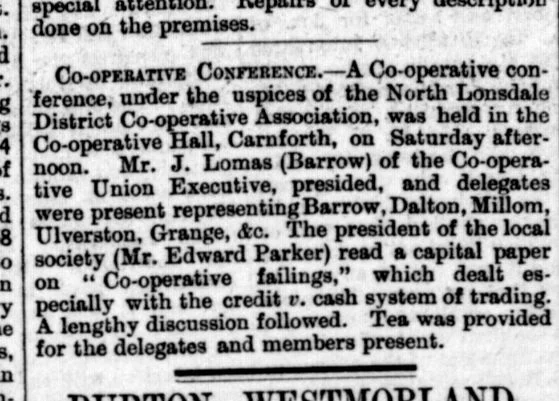
[Ed Further research has confirmed the following: The 1891 census for Howard Cottages shows Edward (39) born in Leeds is living with Mary (37) also born in Leeds, all the children are born in Carnforth Beatrice (Beattie) (12), Clara (11), Harry (8), Ernest (6), Arthur (4) and is employed as a chief inspector of railway rolling stock. Edward and are are still living at Howard Cottages on the 1901 census with only their three sons living with them. Edward Parker was the President of the Carnforth Co-operative Society – 8th December 1893 Lancaster Standard and County Advertiser
Published in Mourholme Magazine Issue 2 Winter 1982