Sheila Spencer
Heroism and tragedy – not what I expected to uncover when I happened to look through the church visitor book in St. Johns Church, Silverdale, and noticed an entry referring to the war memorial to Maurice Briggs (situated on the wall of the North nave) made by a Raymond Haffner, who had written how he had known Maurice Briggs as a boy in Cliviger in Holme, and explained that he had been best man to his brother George. He invited contact should anyone want to find out more about him.
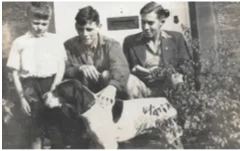
My interest was captured! I had seen the memorial and often wondered who Maurice Briggs was and how he came to be killed in Canada two days after VE day. This was the spur that I needed and I discovered that not only Maurice, but also his older brother Gilbert had both died tragically in air accidents, one before the start of the war and one at the very end. Maurice Briggs was born in Todmorden, West Yorkshire, on 6th May 1920, and his brother, Henry Gilbert Stewart Briggs in 1916. Whilst their father was headmaster at Todmorden Grammar School, the two brothers attended school in Burnley.
In the 1920’s the family moved to Cliviger in Holme, and then in 1936 to Silverdale, taking up residence at ‘Glenroyd’ on Cove Road, now the home of the Bodenham family, but at that time owned by Richard George Lambert. Maurice and Gilbert owned a dark green Bentley car at the time, which some of the older Silverdale residents may well remember.

Maurice Briggs driving the family’s green Bentley
The brothers joined the RAF before the start of the war. Tragically on 9th January 1939, at the age of 22, Gilbert Briggs who was training to be a navigator and based at Prestwick, was killed along with his three fellow crew members whilst engaged in a Cross Country Navigation Exercise, when their Avro Anson plane crashed into the Coserine mountain at Rhinns of Kells, 9 miles West of Dalry, Kirkcudbrightshire. The weather at the time was very poor with freezing temperatures. He was given a military funeral and is buried in Silverdale churchyard.
Maurice, who had joined the RAF in 1937 at the age of 17, was at the start of hostilities in 1939, posted to 77 Squadron as an air gunner/observer based at Driffield. He completed his first tour with distinction and in September 1940 was awarded the Distinguished Flying Medal to recognise his valour, courage and devotion to duty whilst flying in active operations against the enemy. In November 1941 he received his commission and in October 1942 he was promoted to Flying Officer. In April 1942 he began initial pilot training at Torquay, which he completed in Calgary, Canada and was awarded his pilot wings on 2nd April 1943.
In April 1943 the 1409 Meteorological Flight (part of the Pathfinder Unit) had been formed and equipped with DeHavilland Mosquito aircraft which were unarmed, light and amazingly fast. The primary function of 1409 Met Flight was to ascertain weather conditions, the consequences of which could mean cancellation of an operation for the whole scheduled bomber force. Prior to this many aircrews had been killed by bad weather, icing of the plane being particularly dangerous. The pilots and navigators of this new unit were all specially selected and described as ‘young in years but old in flying experience’.
They together with their aircraft stood ready to take off at a moment’s notice, flying when other aircraft of Bomber Command were grounded due to the weather conditions. They faced extreme danger, not only from the weather but also having to proceed alone, deep into enemy territory, in unarmed aircraft, often in broad daylight with no cloud cover.
In November 1943 on his return to England, Maurice was promoted to Flight Lieutenant and posted to this unit, completing well over a hundred sorties, most of them with a John Custance Baker, his navigator. In an official report the two men were described as a perfect team, whose flights were often eventful and dangerous, and who delivered factual and accurate reports. On one occasion for example, in January 1944, Maurice had to ditch their plane in the Channel after they had flown through flak over the Ruhr, had a fire in the cockpit – and finally an engine failure.
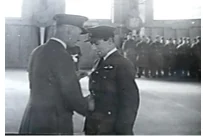
It was in this period that Maurice earned the DFC and DSO – the Distinguished Flying Cross in October 1944 for great determination and exceptional meteorological ability in bringing back accurate data, and the Distinguished Service Order in March 1945. In the official citation it stated, ‘that he had never allowed the heaviest enemy opposition or adverse weather deter him from completing his allotted task and in consequence of his undoubted courage and determination he invariably obtained excellent results. His reliability and devotion to duty have been of the utmost value to his unit.’
Maurice flew his last sortie of the war in December 1944, and over the next few months, together with John Baker, made several trips to Canada to transport Mosquitos from the De Havilland plant in Ontario to England. At the beginning of May 1945 on account of their excellent team work the two men were selected to take a Mosquito to Canada as part of the Victory War Bond Drive. The plane known as F for Freddie was famous in its own right, having flown at least 213 combat operations, which was the highest record for any Allied bomber in WWII. They arrived in Calgary on 9th May, three days after Maurice had celebrated his 25th birthday, and the day after VE day. Hundreds turned out to greet their arrival and were thrilled by a spectacular air display put on by Maurice in a celebration to mark the end of the European war. The crowds flocked to the airport to see the famous plane and meet its crew, many taking the opportunity to buy a bond and chalk their name on the plane.
Unbelievably and tragically 24 hours later Maurice Briggs and John Baker would be dead, and the remains of F for Freddie scattered across the aerodrome.

The following day at 4pm, scheduled to fly the plane to other air bases, Maurice taxied the plane down the runway. Before departing he once again put on a display for the benefit of the spectators who had gathered, making two successful low level passes over the airfield. Tragically on a final daring pass the wing of his aircraft clipped a metal pole above the control tower causing it to crash in a field a third of a mile from the terminal building, where it exploded into flames. The two men, although thrown clear from the wreckage were both killed instantly.
Two days later, Maurice Briggs and John Baker, escorted by an honour guard of 100 airmen, their coffins draped with the union jack and adorned simply with their hats and a single rose, passed through streets lined with hundreds of shocked and saddened mourners, on their way from a church which had been filled to overflowing to the cemetery. After a full military funeral they were buried side by side, in the Field of Honour in Burnsland Cemetery, Calgary.
The funeral procession marching through the streets of Calgary. The shock at the tragic circumstances of their deaths was felt by many. One of their old commanders wrote how their deaths had upset him more than any that he had come across in the war. The Lancaster Guardian reported how the death of Maurice ‘had cast a gloom over Silverdale’, and The Globe and Mail newspaper of Toronto -‘that a deep sense of personal loss was felt by thousands. These two young men were all we always thought the ideal fliers should be, modest and pleasant. They were the pride of a proud command. Maurice Briggs had flown the amazing number of 145 flights and John Baker 115. It was men like Maurice Briggs and John Baker who helped to save the worlds freedom.’
We should also spare a thought for Mrs Margaret Stewart Briggs who, having been widowed shortly after the tragic death of her eldest son, must have believed with the greatest of relief that her remaining son had managed to survive the war. We cannot begin to imagine her grief and devastation upon receiving the tragic news of Maurice’s death coming so soon after VE day. Mrs Briggs continued to live alone at Glenroyd. In 1947 the house was converted into two flats, with Mrs Briggs living on the top floor and Richard Lambert and his family living on the ground floor. In 1959 she moved into Maryland care home in the village, and died in Lancaster Royal Infirmary on 1st October 1959.
First published in Mourholme Magazine Issue 75 Spring 2019
The data is the editor’s interpretation of documents from:
- The National Archive
- Commonwealth War Graves Commission
- Find My Past (this can be viewed free of charge in local UK libraries if you are a library member).
- Ancestry.co.uk (this can be viewed free of charge in local UK libraries if you are a library member).
- Everyone Remembered.